Close looking
The Campbell Sisters: A Waltz Held in Marble
Lorenzo Bartolini turns a double portrait into a study of shared rhythm, using carved drapery, linked bodies and polished marble to hold a passing dance in view.
21 July 2026 · 3 min read
The portrait begins to turn
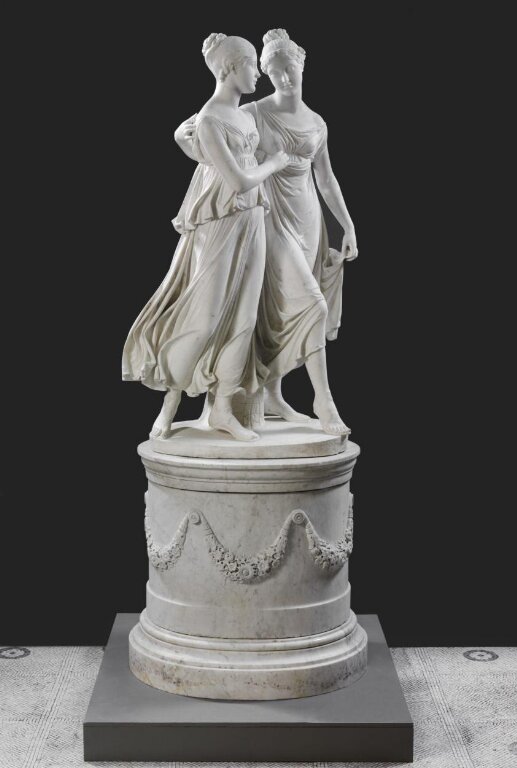
Lorenzo Bartolini carved this marble group in Florence in 1821–22. Its subjects are Emma and Julia Campbell, the youngest daughters of Lady Charlotte Campbell. Rather than arranging the sisters as separate sitters, Bartolini joins them in a waltz: they turn toward one another, step forward together and depend on the same shared rhythm. Portraiture becomes an action unfolding between two people.
The figures wear flowing, high-waisted dresses and sandals. Their linked pose creates both the image of affection and the practical logic of balance. A carved tree trunk rises between them as a support, but the eye follows the sisters’ bodies around it—from one face to the other, through the meeting of their arms and down toward their advancing feet. The work asks to be viewed in the round, as though the spectator were circling the dance.
Making movement from weight
The figure group and its integral base stand 170 centimetres high. Beneath them is a separate marble plinth measuring 92 centimetres in height, so the full installation gives this intimate exchange a distinctly monumental presence. The scale matters: the sisters are not a small decorative vignette but bodies sharing the viewer’s space, held at the instant when stillness appears about to give way.
Carrara marble fixes that instant in a material associated with weight and permanence. Bartolini uses carved drapery, shifting posture and the turn between the two figures to make the stone suggest continuous movement. Light travels across the polished surfaces and gathers in the deeper intervals between bodies, fabric and support. What appears soft or fleeting is produced through decisions about mass, undercutting and the security of the structure.
A dedication inside the sculpture
The supporting trunk carries Bartolini’s name and a dedication to the British sculptor John Flaxman. That inscription makes the group more than a family likeness: it also records an artistic relationship and places Bartolini’s own authorship inside the object. A device required to support the marble therefore becomes a surface for memory, allegiance and signature.
The sculpture’s Neoclassical language is visible in its clear contours, pale stone and controlled arrangement, yet its effect depends on close observation of an ordinary human exchange. The dancers do not perform a grand public drama. Their subject is coordination—two sisters negotiating pace, proximity and touch. The contrast between formal marble and familial intimacy is what keeps the composition alert rather than merely ceremonial.
What the museum record adds
The V&A record connects the finished marble to an earlier stage in its making. The writer Mary Berry saw Bartolini’s terracotta model of the Campbell sisters in Florence in June 1821 and recorded the dancers’ pose and flowing drapery. Her account helps anchor the sculpture’s date while reminding us that the apparent ease of the marble began as a more responsive model shaped before carving.
The Victoria and Albert Museum acquired the work jointly with the National Galleries of Scotland, supported by the National Heritage Memorial Fund and Art Fund in memory of A. V. B. Norman. Those details do not replace looking, but they show why a sourced record matters. Dates, dimensions, identities, inscriptions and ownership allow the sculpture’s movement to be read as a particular encounter preserved across material, family history and museum stewardship.